Design · 7 min read
Natural hairline design: the centimetre that decides the result
Whether a hair transplant looks natural is usually settled in the front centimetre.
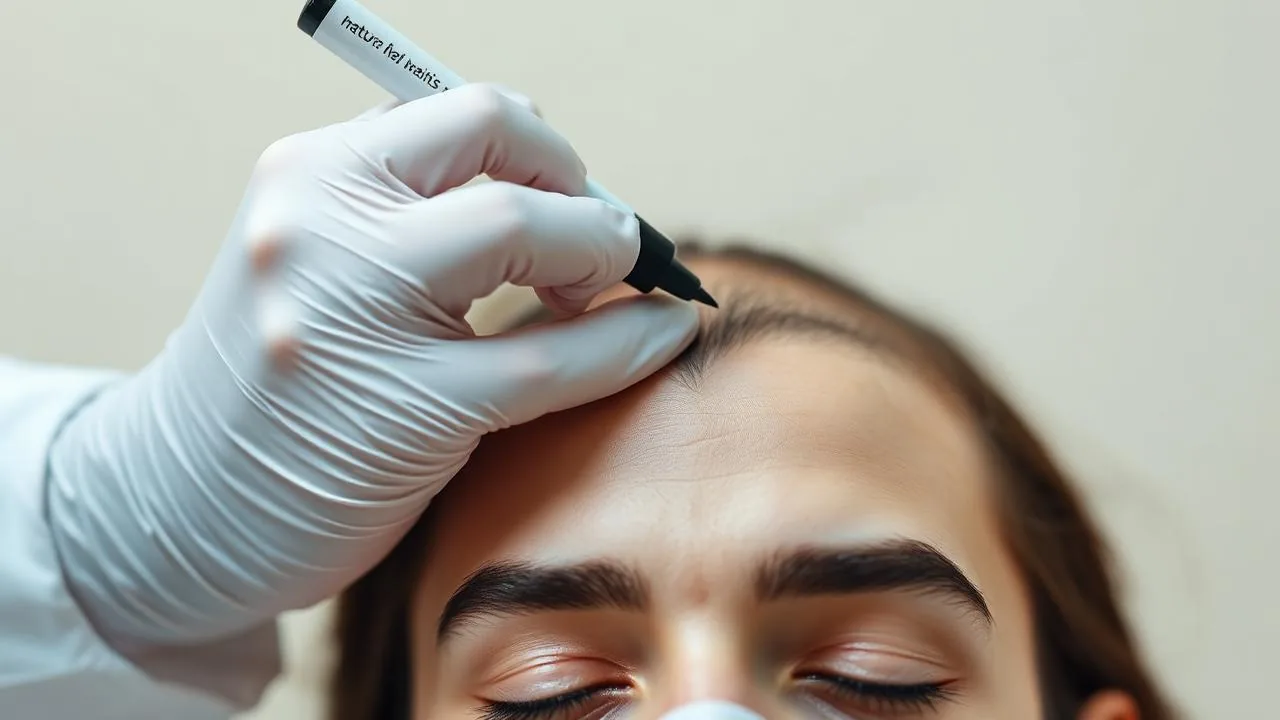
Someone looking at a hair transplant result cannot see the graft count and does not know the technique; all they notice is whether the hairline looks natural.
That is why, at our clinic, the design stage is one of the parts of the procedure given the most time, and it is always led by the physician.
How is the height of the line decided?
The hairline is positioned just above the highest point at which the forehead muscles move. The classic reference is roughly 7–9 cm above the brow; that value is then individualised according to face length, the slope of the forehead and age.
Age-appropriateness is a critical rule. Designing a 20-year-old's hairline for a 25-year-old patient leaves an artificial look at 40. Good design accounts for how the patient will look twenty years from now.
The secret of naturalness: controlled irregularity
In nature no hairline is straight as if drawn with a ruler. The front row is made of micro indentations and projections, irregular spacing and single-hair grafts.
In the second row a transition zone is built with two-hair grafts, and density increases gradually towards the back. Without that gradation you get a line that stands like a wall — and looks artificial.
- The front row must consist of single-hair grafts only.
- The transition zone is planned at a depth of at least 1–1.5 cm.
- The temple corners are left open to a degree appropriate to age.
Channel angle and direction
At the front, hair leaves the skin at a narrow angle of roughly 30–45 degrees, pointing forwards. At the crown it follows a spiral direction around the whorl.
If the channel angle is wrong the hair stands upright: it will not comb, will not lie flat, and will not look natural however dense it is. An error of angle cannot be compensated for with graft count.
The design is approved with the patient
At our clinic, once the drawing is complete the patient sees their own hairline in a mirror, it is photographed, and no channel is opened before written approval is given. That step removes most of the expectation mismatches that would otherwise surface later.
Frequently asked questions
Can I bring my hairline as far forward as I like?
Technically possible, but not advisable. A line brought too far forward consumes the donor reserve as loss progresses and leaves an unnatural appearance.
Are the temple corners filled in too?
They are, if that suits your facial proportions; but leaving them open to an age-appropriate degree makes the result more natural.
All articles
Techniques
Sapphire FUE or DHI? Which technique suits you
Choosing a technique is not a matter of fashion but a decision specific to the case. Here are the real differences between the two methods.
Planning
How is the graft count decided in a hair transplant?
"How many grafts do I need?" has no single correct answer. Donor capacity, the degree of loss and the density you are aiming at are calculated together.
Planning
Cheap hair transplants: what is cut when the price falls?
Most of the cost of a hair transplant is team time, consumables and sterile conditions. Those are fixed — so when the price falls, something is being cut.
Free remote assessment, no obligation.
Book a consultation