Hair transplantation
Sapphire FUE, DHI and no-shave procedures — what each one suits, what it cannot do, and how the first year unfolds.
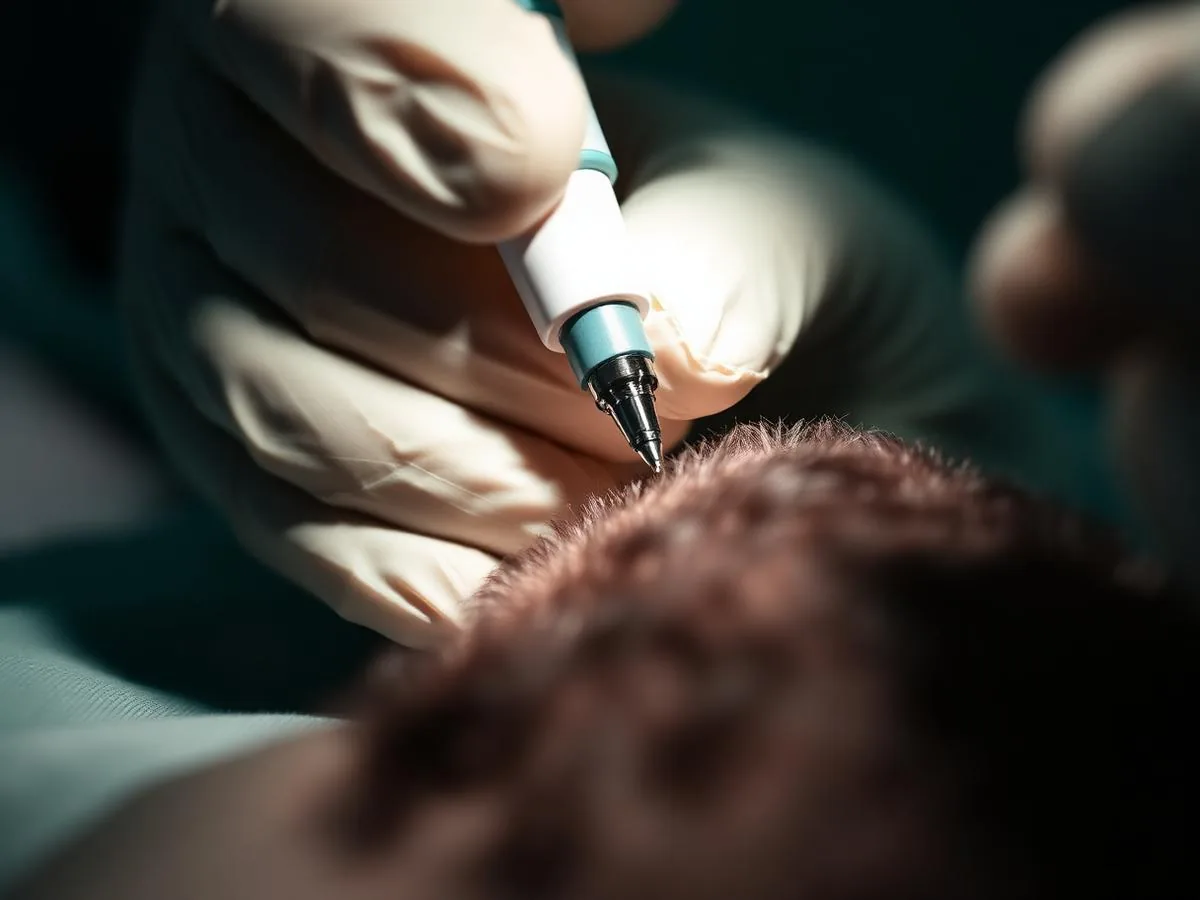
Hair transplantation relocates follicles that are genetically resistant to hormonal loss from the back and sides of the scalp into thinning or bald areas. The relocated follicles keep that resistance, which is why the result is permanent. What varies between techniques is how the follicles are extracted and placed — and therefore how much area can be covered in one session and how visible recovery is.
- Procedure time
- 6 – 8 hours (single session)
- Anaesthesia
- Local, with an anaesthetist present
- Back to work
- 3 – 5 days (desk work)
- Final result
- 12 – 18 months
Who is it for?
Suitable candidates
- Men with a stable pattern of loss and sufficient donor density, typically Norwood 3–6
- Women with a high hairline or diffuse thinning where the cause has been investigated
- Patients wanting densification between existing hairs rather than full coverage
- Beard, moustache and eyebrow restoration where the donor area allows
When it is not appropriate
- Loss that is still progressing rapidly in a young patient — medical management comes first
- Insufficient donor density for the area the patient wants covered
- Uncontrolled diabetes, bleeding disorders or active scalp infection
- Active scarring alopecia; the condition must be quiet for at least a year first
Suitability is confirmed only after examination and blood tests. The information on this page is general and does not replace individual medical advice.
The procedure day
- MorningBlood test results are reviewed, the hairline is drawn with you and signed off before anything begins.
- Part oneThe donor area is prepared, local anaesthesia is applied and grafts are extracted one by one with a micromotor.
- BreakGrafts are separated under magnification and counted; you take a meal break during this stage.
- Part twoChannels are opened at the natural exit angle and grafts are placed following hair direction.
- DischargeThe donor area is dressed, the aftercare kit and written instructions are handed over, and the first wash is booked for the next day.
All hair transplant treatments
Each procedure has its own page: who it suits, how it is done and how the first year unfolds.
Sapphire FUE Hair Transplant
The standard choice when a wide area needs dense coverage in one session.
DHI (Choi Implanter) Hair Transplant
The precise option for densification and no-shave procedures.
Beard & Moustache Transplant
Beard volume with a line designed to your facial structure.
Eyebrow Transplant
Symmetrical, permanent and natural eyebrow design.
PRP & Hair Mesotherapy
Support after a transplant and treatment for early-stage shedding.
Women's Hair Transplant
A no-shave, privacy-focused protocol for women.
Unshaven Hair Transplant
No cutting in the recipient area — and an honest account of what that costs you.
Recovery timeline
- Days 1–3
- Swelling may move from the forehead to the eye area. The first wash is done at the clinic and the technique is taught.
- Week 1
- Crusting begins. Crusts are softened, never picked; the washing routine continues daily.
- Weeks 2–4
- Shock loss occurs. Transplanted hairs shed while the follicles stay in place — this stage is expected.
- Months 3–6
- New growth appears, initially fine and pale, thickening over the following months.
- Months 12–18
- The result matures. Thick or wavy hair can take up to eighteen months to settle.
Frequently asked questions
Sapphire FUE or DHI — which is better?
Neither is superior in the abstract. Sapphire FUE moves more grafts in one session and suits large, fully bald areas. DHI works between existing hairs and is the first choice for densification and no-shave procedures. The decision follows donor structure and the density you are aiming for.
Does the procedure hurt?
It is performed under local anaesthesia, so you feel no pain during the procedure itself. Discomfort during the anaesthetic injections is reduced with a pressure device. Mild tightness on the first night is normal.
When can I fly home?
Usually two to three days after the procedure, once the first wash has been done at the clinic. Avoid letting luggage knock against your head and use a loose hood rather than a cap.
Will my existing hair keep falling out?
Possibly. A transplant replaces what has been lost; it does not stop ongoing loss elsewhere. A medical support plan is discussed separately for that reason.
Can I have a second session later?
Yes, if donor capacity allows. Good planning always stays below capacity so a second session remains possible — over-harvesting the donor area cannot be undone.
What decides the cost is covered on the pricing page; travel and accommodation on the medical tourism page.