Planning · 10 min read
Revision hair transplant: can a bad result be corrected?
Not getting the result you wanted from a first procedure is common. Some things can be corrected and some cannot. Knowing the difference prevents a second disappointment.
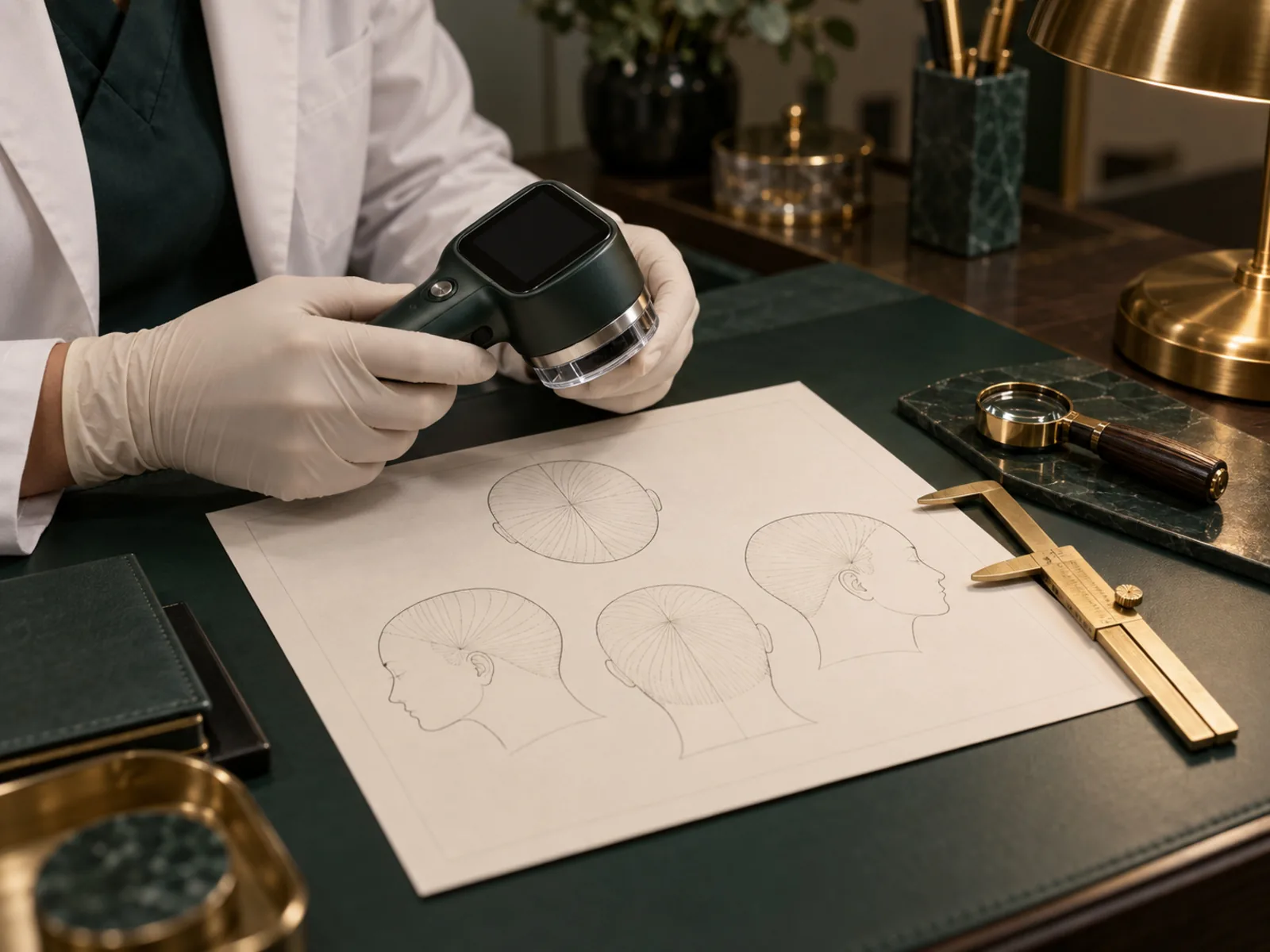
A revision hair transplant is a second procedure planned to correct the result of an earlier one. The demand is more common than people assume, and it comes up particularly after procedures where the graft count was never documented or the hairline was not designed for the patient's age.
The aim of this article is not to sell hope but to draw the line clearly. Some problems can be improved substantially; others cannot be reversed. That distinction has to be understood before deciding.
Why does a first procedure not give the result wanted?
The pictures we see most often in patients coming for a second opinion resemble one another. The problem is usually not the name of the technique but the planning or the quality of execution.
- A hairline drawn too low or too straight for the patient's age and facial proportions.
- The planned graft count not being placed — and because it was never documented, the patient only realises later.
- Grafts placed at the wrong angle and direction; the hair will not comb and stands upright.
- Thick or multi-hair grafts used in the front row; it looks artificial even from a distance.
- Over-harvesting of the donor area; the back of the head thins permanently.
What can be corrected?
The following problems can be improved markedly, provided donor capacity allows:
Insufficient density: densification between the existing hairs with DHI.
A straight, artificial-looking hairline: a new line with micro-irregularity can be built in front of it with single-hair grafts.
Empty temple triangles and uneven transitions can be completed.
The linear scar left by the FUT (strip) method can be camouflaged substantially by placing grafts into it.
What cannot be corrected?
To be honest, there is very little that can be done in two situations. Saying so at the outset prevents a second disappointment.
The first is an exhausted donor area. Capacity at the back of the head and above the ears does not regenerate; if over-harvesting has taken place, there are no grafts left to take. Beard and body hair can make a limited contribution here, but they are not a substitute for scalp grafts.
The second is dense grafts placed at the wrong angle. The direction of existing grafts cannot be changed; the appearance can only be softened by placing new grafts around them at the correct angle. In some cases the only solution is removing the misplaced grafts one by one — which puts further strain on donor capacity.
The one thing that decides: donor capacity
In revision planning the first question is not what the patient wants but what the donor area can give. Density at the back of the head is measured, the marks of the previous procedure examined, and the number of grafts that can realistically be taken established.
A promised number given without that measurement should not be taken seriously. There is no margin for error in a second procedure: if the remaining capacity is spent badly, there is no third chance.
When can it be done?
At least 10–12 months are left after the first procedure. The reason is not patience but measurement: the final result of the placed grafts appears at month twelve, and only then can you see what is genuinely missing.
Revisions done earlier risk placing grafts on top of ones that have not yet come through. That period is shortened only where there is a medical necessity, such as an infection or a marked tissue problem.
What to bring for a second opinion
Information about the first procedure matters if the assessment is to be accurate. Bring whatever you have:
- The date of the first procedure and any document showing the graft count placed.
- Your own photographs from before and after the procedure.
- The medical support products you used and for how long.
- Any pathology or test results.
- Fresh photographs from the top, the front, both sides and the back of the head.
What is a realistic expectation?
A revision is not a return to the state before the first procedure. The target is a result measurably better and more natural than the current one.
Where remaining donor capacity is limited, priorities are set: usually the hairline, the area most looked at, comes first, and the crown is left until later or not planned at all. Those choices are made openly, with the patient.
Frequently asked questions
Can a failed hair transplant be completely corrected?
"Completely" is not the right word. Increasing density, correcting the hairline and camouflaging scars produce marked improvement in most cases. But an exhausted donor area and dense grafts placed at the wrong angle set the limit; in those two situations the result stays partial.
How many hair transplants can a person have?
There is no technical upper limit on the number; the limit is set by donor capacity. Each procedure reduces what remains, so every session's plan has to account for the next one.
Can my FUT scar be covered?
Grafts can be placed into the linear scar left by the strip method and the scar becomes markedly less visible. Expecting it to disappear entirely is not realistic, because the scar tissue beneath remains.
Can beard or body hair be used?
Where the donor area is insufficient, beard and body hair can be used as support. Those hairs have a different calibre and growth cycle; they are used for volume in the areas behind, not at the hairline.
Is a revision more expensive?
Planning and execution are more demanding, so the procedure can take longer. The figure, as in any procedure, is set by graft count, technique and scope; no number is given before an assessment.
All articles
Techniques
Sapphire FUE or DHI? Which technique suits you
Choosing a technique is not a matter of fashion but a decision specific to the case. Here are the real differences between the two methods.
Planning
How is the graft count decided in a hair transplant?
"How many grafts do I need?" has no single correct answer. Donor capacity, the degree of loss and the density you are aiming at are calculated together.
Planning
Cheap hair transplants: what is cut when the price falls?
Most of the cost of a hair transplant is team time, consumables and sterile conditions. Those are fixed — so when the price falls, something is being cut.
Free remote assessment, no obligation.
Book a consultation