Women's Hair Transplant
A no-shave, privacy-focused protocol for women.
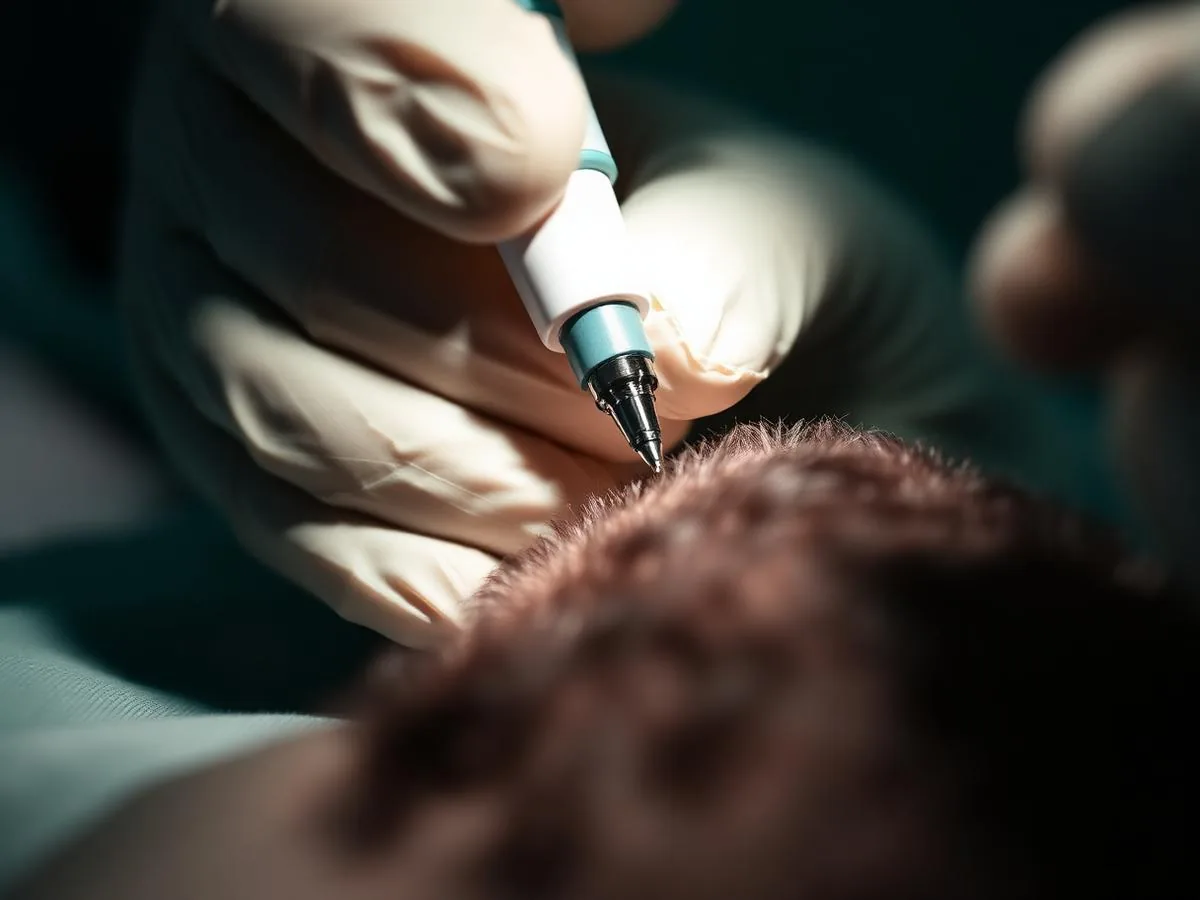
In women, a hair transplant is usually done not to cover a fully bald area but to densify a thinned region and correct the hairline. Because loss in women generally progresses as diffuse thinning, hormonal and systemic causes are investigated first. In suitable candidates, no-shave DHI is used to place grafts between existing hairs, with no cutting of the hair. Social visibility is therefore barely affected.
- Procedure time
- 6 – 9 hours
- Anaesthesia
- Local
- Back to social life
- 2 – 3 days (no-shave)
- Best for
- High hairline, diffuse thinning with a known cause
Who is it for?
Suitable candidates
- A high forehead or hairline the patient wants brought forward
- Thinning at the parting where the cause has been investigated
- Traction alopecia where the pulling has stopped and the area has settled
- Scars from surgery or injury within the hair-bearing scalp
When it is not appropriate
- Diffuse thinning whose hormonal or systemic cause has not been investigated
- Iron, thyroid or vitamin deficiencies that have not yet been corrected
- Active telogen effluvium — the shedding must settle first
- Insufficient donor density for the area being asked to cover
Suitability is confirmed only after examination and blood tests. The information on this page is general and does not replace individual medical advice.
How it is done
- 01
Investigation first
Blood work and a scalp examination look for a treatable cause before any surgery.
- 02
Design
The hairline is planned to your face, usually lowering the forehead rather than covering baldness.
- 03
No-shave harvesting
Only a hidden donor strip is trimmed; the rest of the hair is untouched.
- 04
Placement
Grafts are placed between existing hairs with a Choi implanter.
Recovery timeline
- Days 1–3
- The first wash is done at the clinic. With no-shave, the change is barely visible.
- Week 1
- Fine crusting, hidden by the surrounding hair in most cases.
- Weeks 2–4
- Shock loss, which may include some existing hairs in the area.
- Months 3–6
- Density begins to build; the parting looks fuller.
- Months 12–18
- The result matures and blends with the existing hair.
Frequently asked questions
Will my hair be shaved?
In the no-shave protocol, no. Only a strip in the donor area is trimmed and it is covered by the hair above it. This is the standard approach for women and it is why most patients return to normal life within a few days.
Why do you investigate before offering surgery?
Hair loss in women is more often driven by a systemic cause — iron, thyroid, hormones, or a period of stress — than by a fixed pattern. Transplanting into an area that is still actively shedding wastes grafts. Blood work first is not a delay; it is what makes the plan reliable.
Can a high forehead be lowered?
Yes, this is one of the most common reasons women have the procedure. Grafts are placed to bring the hairline forward and soften the temple points, planned to your facial proportions.
Is the result as durable as in men?
Follicles from the donor area keep their resistance to hormonal loss in either case. What differs is that diffuse thinning elsewhere can continue, so a medical support plan is usually discussed alongside.
Other treatments
Sapphire FUE Hair Transplant
The standard choice when a wide area needs dense coverage in one session.
Hair TransplantDHI (Choi Implanter) Hair Transplant
The precise option for densification and no-shave procedures.
Hair TransplantBeard & Moustache Transplant
Beard volume with a line designed to your facial structure.
Hair TransplantSend your photos, receive a written plan
A free remote assessment, with no obligation to proceed.